Saturday, May 28, 2022

Montague Rhodes James, 1862-1936

Athenaeum

Thursday May 26th, I enjoyed a splendid evening at the Athenaeum when Robert Lloyd Parry delivered an exact re-creation of an important lecture, The Abbey Church at Bury, given by M. R. James in the self-same Athenaeum on 21 April 1932, four years before his death. Dr Richard Hoggett, a heritage consultant, lecturer and writer, found the hand-written, pencilled original text among M. R. James’s papers in Cambridge University Library in 2018 and eventually published it in 2020. He introduced the Thursday evening performance with an interesting resume of James’s distinguished academic life which saw him as Vice Chancellor of Cambridge University [briefly], Director of the Fitzwilliam Museum and from 1918 to 1936, Provost of Eton College.

James was a fine mediaeval scholar with wide-ranging academic interests though, above all, he had a life-long fascination with St Edmund’s Abbey and, after extensive research on his passion, published a seminal two-part volume on the Abbey in 1895, applauded as the single most important piece of research by an individual since the Dissolution of the Monasteries. James became the leading expert on the Abbey mediaeval manuscripts and the history and lay-out of the great abbey. During his research, he uncovered a reference in an Abbey register in Douai to the burial places of several of the early Abbots. This eventually led, in 1902/3, to excavations in the Chapter House, pinpointed by James’s research, when the graves of five abbots were duly unearthed together with a sixth, uncoffined. The skeletons were lifted, studied and photographed before being replaced with solemn ceremony. New stone lids were made by local masons, Hanchets, inscribed with the abbots’ names and placed over the coffins, where they can be seen today.

Robert Lloyd Parry as M. R. James
In fact, during his lifetime, M. R. James was most popularly known for his highly-regarded ghost stories and Thursday evening’s performance actor, Robert Lloyd Parry, arrived at his interest in James’s academic revelations through performing his peerless ghost stories in public. He has brought solo performances of, and documentaries about, M. R. James’s creative work to a wide audience and his Thursday evening appearance in Bury was evidence of both his dramatic skills and his strong feeling for his subject. The audience felt they were hearing James himself talking about his huge scholarly passion for the history of the Abbey. A superb performance.

The audience was welcomed to this special event by the Chairman, Adrian Tindall, of the Abbey of St Edmund Heritage Partnership which promoted the performance, supported financially by the Bury Society.

For me, personally, Thursday’s occasion was an excellent opportunity to look around the inside of the Athenaeum for the first time. It is one of the town's most iconic buildings, purpose-built in the early 18th century as the Assembly Rooms where people could meet to play cards and attend balls. Subsequently, it was re-named the Athenaeum in 1854 enabling the Grade 1 listed building to become available for hire. The stunning spaces within include the Georgian ballroom with its chandeliered ceiling and grand decor, while outside, the entrance is entitled, 'Subscriptions', a Dickensian touch one feels. Famous names associated with public readings and performances there include, indeed, Charles Dickens and also, Oscar Wilde.

The five stone coffins, burial places for five Abbotts.
Revealed on January 1st, 1903 in the Chapter House.
The five were Abbotts Sampson, Richard de Insula,
Henry, Edmund de Walpole, and Hugo.
Montague Rhodes James
1862-1936.
He described his famous appearance at the 
Athenaeum, as having given 'a vast, 
stirring lecture.'
1903 First edition of James's 
Ghost Stories of an Antiquary.


Monday, May 23, 2022

Wedding weekend and a visit.


Part of the group on May 14th; many
more pics available!

More or less recovered energy after a weekend of celebration, family fun, inspiring ceremony, exhaustion, followed by Bletchley Park outing and more fatigue after a long day!

Part of the 17th century barn, ready for
the ceremony. 

Guest place setting for 
David who skis.
Eldest grand-daughter got married at Elms Barn near Beccles in Norfolk, at a superbly-organised event last weekend. [Gay Day was May 14] The happy pair had had plenty of time to organise, courtesy of Covid et al, but even so, the whole weekend was so amazingly organised with attention to detail and individual attendees’ personal interests and characteristics, that everyone was kept in a state of delight and amazement. The actual venue was stunning; Queen Anne house with later farm buildings, cottages and outhouses of impressive proportions providing great accommodation about which there was but one moan. Mine. My room was chiefly wi-fi free and to my bemusement, could only be accessed by propping open the door! A solution discovered by techie son-in-law with a Google degree! How did that work? Who knows but it did allow me to enjoy Netflix in bed as usual!! Must alert the manager to the need for an extra router!

But I have yet to mention, nay, eulogise, the exceptional 17th century barn, magnificent in its ancient glory with beams to die for and wonderful brickwork. This barn hosted the wedding ceremony and later the feast, though much of the post-meal music was outside the huge, fixed marquee, on a patio leading to the extensive and beautiful gardens. Somehow, the girls had found a great singer whom I want to

Some of the beautiful gardens.

grace my Celebration of Life when it occurs after my departure!! I should add that, somehow, the warm sunny day extended to late evening and to the many oft-repeated tributes to A Perfect Day. One of my grandsons, when asked to define his perfect day, answered that this was it; everyone having a super time, family and friends in a complete, spontaneous and joyful harmony. I really liked that, and hugged myself in delight when I heard it.

Only three days later as I resumed normal power, I was able to join [late cancellation] a U3A trip to Bletchley Park which I have long wanted to visit. I was unsure if the declining energy was equal to the nine or ten hours involved and it somehow was, just! But it was a privilege to be there. We joined a previously-booked guided tour which turned out to be not only informative but fun and really interesting. The guide had reached a high-level ability to keep minds interested, entertained, educated and wanting more; no mean achievement.

Bletchley Park is an English country house and estate near Milton Keynes; the actual grand house is a bemusing mixture of Victorian Gothic, mock Tudor and Dutch Baroque and, externally, lacks coherence and beauty. However, architecture was not a prime consideration when Bletchley Park was selected to become the principal centre of Allied code-breaking during the Second World War. The mansion was constructed during the years following 1882 for the financier and politician Sir Herbert Leon and was 

Ambulance used at Bletchley between 1938-1945..

   Polish Lorenz machine.
chosen for its reasonable proximity to access to London and the infrastructure necessary for the growing telecommunications traffic. During World War II the estate housed the Government Code and Cypher School which regularly penetrated the secret communications of the Axis Powers – most importantly, eventually, the German Enigma and Lorenz ciphers. The war work, a prolonged intellectual de-coding hunt, was of huge importance in the war effort and the first appointees tended to be from academe, numbering initially around 200, though by 1945 there were almost 9,000 people burrowing there. Two friends, sisters, who lived in the same village as I in the Eighties and Nineties, had been plucked from their Sixth Forms in turn to work at Bletchley and, like everyone else, were bound by the Official Secrets Act; each chose not to tell the other what they did at Bletchley for around fifty years!!

My greatest thrill on the visit, was to enter Alan Turing’s rather mundane office. A polymath, he had been the brightest of Bletchley recruits and was definitely the most eccentric. His work was pivotal to the successful Cracking of the Code; indeed, he is known as the man who broke Enigma. He is described as a mathematician, computer scientist, logician, philosopher, cryptanalyst, and theoretical biologist. He was the Father/Founder of computer science and would have done SO much more for Britain’s web-world had he lived beyond 41. He committed suicide after suffering chemical castration following a public order conviction. His crime had been to be gay in a less enlightened period; he committed suicide two years after his conviction and ‘treatment’. A huge loss of an immense talent.

Alan Turing's office.,

Alan Turing. 


Distant view of the house; the all-important
wartime Bletchley Park.
Grandson popping the cork; perhaps 
at the barbecue the night before!


Monday, May 16, 2022

Glorious Idiosynchronicities


Theatre Royal, Bury St Edmunds.

 Bury St Edmunds turns out to be a lovely place to live; pretty and spacious; a wide sweep of historical buildings and Georgian squares; the wonderful Abbey Gardens combining historical and aesthetic appeal; a Regency theatre plus the Apex for plays, appearances, concerts, ‘conversations’ and the Athenaeum which seems to be a public space for various events like talks and discussions. And, there is an abundance of bars, cafes, coffee shops, restaurants covering a wide range of tastes and purses plus two market days each week.

But my title points to the shops and businesses. I am frequently entertained when I walk to the shops to notice not one, but two sweet shops. When did sweet shops exist? When I was a girl I think. But here we have Mr Simms’ Olde Sweet Shoppe on the Butter Market and nearby, the tiny Auntie Pam’s Sweet Shop, both of which seem to dabble in nostalgia, selling a thousand sugary treats mostly from a bygone era, such as Sherbet Fountains, Flying Saucers, Midget Gems, Sherbet Lemons [my childhood favourite though rarely allowed]. It is true that there are modern and more sophisticated establishments which could not be described as sweet shops, more posh chocolate shops. There are the Marimba Chocolatier and Hotel Chocolat, either of which would gain my adult vote. But I DO enjoy that there is space and appetite for the others.

In a similar but slightly different vein are the number of places which similarly advertise clothes 

One of several available but a very
individual and stylish logo!
alterations and dress-making. I am not at all sure that I have seen them all but it is faintly astonishing that there is a market for so many! I have seen May Alterations; Magic Stitching; Amma Alterations & Boutique; Fast Stitch; A J’s Alteration; Sylwia Style plus Farthing’s Dry Cleaners which also offers clothes re-modelling. What can there be in the area of Bury St Edmunds to keep so many outlets going? Is it poverty? Is it thrift? Is it necessity? Is it modishly ‘green’? Is there a conduit for designer clothes so precious that the owners choose revisions and re-designs of the originals to extend the lives of expensive garments? No one knows, surely, but it is a welcome eccentricity which adds to the appeal of this ancient little market town.

Lounge and Garden Cafe,
Hatter Street.
I have also discovered an unexpected facet of cafe life in the Lounge and Garden, Hatter Street, a large cafe with a lovely outside sitting area. They not only tolerate, but actively welcome, customers who play games like cards I am now in two small groups which are learning to play Mah Jong; every Monday and Friday afternoon; the staff reserve a perfect corner where four or five of us can play and no doubt, as expertise is gained and we grow in size as a group, the cafe ‘girls’ will be pleased to reserve two neighbouring tables for our two hour session. What could be more companionable and importantly, effortless?

In the Butter Market there is a shop called Luna House Boutique with what, a casual passer-by might register as assorted junk in the windows. There are lots of clothes and other interesting old items advertised in the modern parlance as ‘pre-loved’! But it was chiefly clothes which I registered as I passed by in a faintly disinterested way, until last week when I stopped for an idle glance and was riveted by the sight of a vintage watering can in the window. Its appearance of faded pewter with touches of authentic rust enchanted me and in no time at all, I was the proud owner of this pre-loved beauty, placing it carefully on my longer terrace where it adds lustre and style! Bury St Edmunds scores again!

Luna House, Butter Market.


But possibly, la piece de resistance, is an actual BAKERY!! In Europe, these are not cause for comment but in England, local bakeries are rare now. And here we have Wooster’s in Langton Place, tiny, open four days a week and also hedging its bets by selling a small range of fresh vegetables and dairy items. The bread I buy is dark and filled with multi grains and seeds, and is totally delicious and confers on the consumer a ‘greener-than-green’ aura which is very satisfying indeed!

Wooster's Bakery, Langton Place.


Abbeygate Street, a main thoroughfare.

St John's Street with many small, individual shops and services.
The Athenaeum, Angel Hill.
Outside is the legend, 'Subscriptions',
a Dickensian touch which seems apposite!

Monday, April 25, 2022

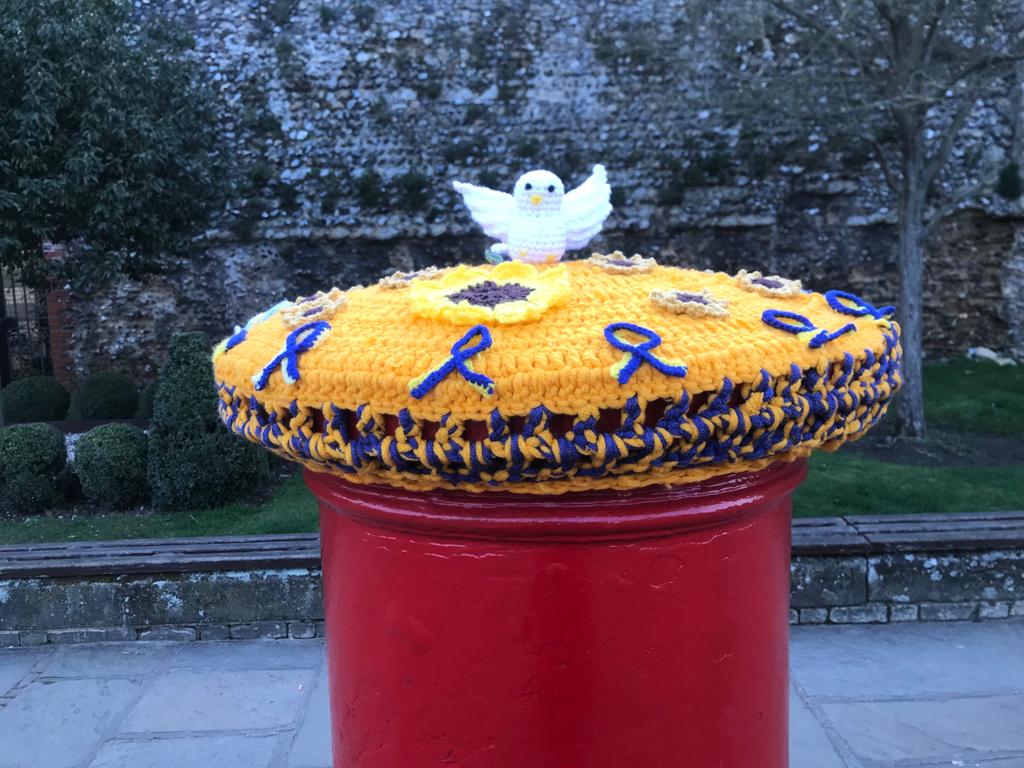
Kniffiti Gangs


Also known as 'Granny graffiti'

Angel Hill,
Bury St Edmunds

 In my first Bury blog, I included an amusing photograph of a knitted/crocheted cap on the pillar box on the far side of Angel Hill and concluded that there was at least one local eccentric with a wry sense of humour. It felt like a delightful welcome to Bury at the time. However, I am now wiser. I discover from reading a copy of The [Impeccable] Times on Easter Saturday, [my newspaper buying is restricted to one a week normally, in the interests of getting other things done.] that, under the heading, “Kniffiti gangs giving street art a new twist” an article described, ‘ a new generation of guerrilla knitters’ sweeping Britain, “yarnbombing” lampposts, letter boxes and fences. Apparently, the youngsters in Generation Z [aged 15-24] are behind the trend and I had naively imagined slightly batty O.A.Ps with time on their hands. Between 2019 and 2021 there was a 53% rise in the uptake of sewing and knitting among girls aged 15-24

Serious  yarnbombing in Mexico.

according to the data analyst, Kantar. The arts and crafts website, Hobbycraft shows that enquiries about ‘
knitting wool’ have risen 178% over the last two months and in the meantime, on the sidelines, my growing suspicion that I am totally out of touch with modern life is strengthened!

This latest craze is called Kniffiti, where a person knits or crochets something and attaches it to an item of public property. One can work out where the verb, ‘yarnbombing’ comes from and the Times article describes one young student who already crochets colourful blankets to add appeal to the outside area of the pub where she works, who is intending to venture further afield and yarnbomb all over the country. This sounds like a serious movement with very cheerful effects. I like it and do wonder if there is a Bury Yarnbombers similar to the already publicised Hertfordshire

5000 woollen poppies at St Mary's,
Walsham-le-Willows. Remembrance
Sunday 2021.

Yarnbombers, already in existence? I am quietly impressed that I am acquiring modern descriptive terms such as yarnbombing even if I am unsure as to when I may be able to show off my mod vocabulary. But I do intend also to keep my ear to the ground in case I get an echo of the identity of the local Kniffiti Gang. I don’t want to join; just to admire and encourage.

And meanwhile, I continue to stroll or even quicken my pace occasionally, on early morning sallies to the Abbey Gardens to enjoy the tranquillity; the pleasing aesthetics of the floral planting; the constancy of the Abbey ruins which both beautify and sadden; the blessed emptiness of the huge green timeless space, an almost deserted natural theatre occupied by extraordinarily bold pigeons and numerous grey squirrels with the grace and speed of miniature furry arrows! I usually try to walk past those few wonderful houses in the West Front at right angles to the Cathedral, built into the stony ruins 

Abbey Gardens tapestry of planting, earlier this week.
left there and conjured up by some 18th century genius. Each time I lust after them despite loving where I now live! After I marvel at the eighteenth century’s skill in integrating living people into historical ruins, I often follow the Circular Walk which takes me about 30 minutes plus, after which I wend my home along different streets. The astonishingly beautiful weather has meant chiefly sunshine and reasonable temperatures so that the much-lauded benefits of early outdoor exercise are reaped! And incidentally I am familiarising myself with some of the layout and names of the streets.

I have also discovered the Hunter Gallery almost opposite the Angel Hotel and through the window display and a visit, thus discovered the stunning art of Edward Nooit. There is a handsome urban study of light and shadow of his in the window, priced, alas, at a little below £6,000 which at present [she writes unrealistically] is beyond a slender purse almost buckling under the weight of plumbing, electrical works, decorating indulged in since arrival in Bury. Plus of course the not inconsiderate costs of attending, suitably attired, two family weddings in May and September. Both much anticipated, of course, and for both of which I now have suitable, not to say, splendid attire!!


An earlier Edward Noott.
Masterly use of light and shadows.

Knitted caps for cobblestones. Handsome!!
Does Brugge know about this trend?

Monday, April 18, 2022

First Impressions


 I am reminded from the blog title that the first title Jane Austen chose for her subsequent Pride and Prejudice, was First Impressions
so I must tread softly less I tread on anyone’s dreams, as W.B.Yeats might have put it.

A strong feature for me immediately, of living in Bury, was of the open and friendly nature of the local populace and the very different street courtesies and public connections from those in Beloved Bruges. I had been used to a similar atmosphere in Wye in Kent where I lived for over thirty years, but that is easier to achieve in a village of two and a half thousand people, than in a medium-sized tourist town. Another strong impression I have gained, is that there is quite a lot of relative poverty in this area though this is not manifested in unease or unhappiness. Not at all; one senses chiefly contentment and acceptance; I have seen any number of “little, nameless, unremembered acts of kindness and of love” [Wordsworth], small courtesies that warm the heart. Truly “the best portion of a good man’s life” as the poet observed. But, nonetheless, there is poverty and quite a sizeable middle class with a gap between the two. Perhaps not surprising then to realise that this is a Conservative stronghold which reminds me that it is time to re-join the Labour Party, now chiefly de-Corbynised.


The Abbey Gardens nearby are stunning in scope, beauty and early mediaeval ruins and were created as such in 1831. That the Gardens are in the centre of town, close to coffee shops and newsagents, still seems remarkably fortunate, demonstrating history living and touching the present day. Thus, in a few square metres from the Angel Hotel, beloved of Dickens, begin the numerous remains of the Abbey of St Edmund, founded in 1020 and once one of the richest and most powerful Benedictine monasteries in England, built to house the remains of Edmund, King of the Angles after his murder by marauding Danes in 869 A.D. His shrine became a place of pilgrimage for hundreds of years. It was here in 1214 that the English barons met to swear the oath that would eventually force King John to accept what became the Magna Carta.

St Mary’s nearby, was built between 1290 and 1490 as part of the Abbey complex. Mary Rose Tudor,

Queen of France, and later Duchess of Suffolk, is buried

St Mary's, Bury St Edmunds
there and a supreme irony is that her Royal brother’s greed and wanton use of his limitless power began the slow decay of the venerable Abbey, stripped of its gold, its treasures, and tragically, its lead. It was largely destroyed by the 18th century. Mary Tudor died six years before the Dissolution of the Monasteries and was initially buried in a splendid tomb in the ancient Abbey before eventually being removed to a much more modest resting place in St. Mary’s.
Mary Tudor, 1496-1533

Then, still in this same small area, is St Edmondsbury Cathedral, built on the site of 1000 years of worship and pilgrimage. Originally dedicated as St James’s Church and built within the precincts of the Abbey in the early 12th century, it was largely re-built in 1503 and promoted to Cathedral in 1914 when the Diocese of St Edmundsbury was created though not until 1959 did renewed construction begin to truly up-grade the church to the status of Cathedral. The Gothic Revival tower was added in 2000 funded by the Millennium Commission and the Cathedral celebrated as complete on July 20 2005.

Unitarian Baptist Chapel, Churchgate Street.

I have noticed several Nonconformist chapels, such as Baptist and Methodist, when wandering the central streets, but I suspect there is quite a convoluted and complex history of a religious tapestry in Bury, other than the Church of England, typical of Nonconformist and Roman Catholic histories elsewhere in England. However, Bury seems to have been strong in different Nonconformist strands. One classic building which has caught my eye is the Bury Unitarian Baptist Church, Grade 1 listed and built in 1711 in the English Baroque style, in Churchgate Street. Constructed of two tone red bricks, it is of beautiful proportions and must be one of the finest buildings in the town. Certainly, its facade is “one of the jewels of Bury” and inside the spacious interior, lit by beautiful windows, there used to be box pews.


St. Edmundsbury Cathedral
Completed 2005.


Baptist Chapel, Garland Street, built in 1834 after its 
congregation outgrew the original premises on
Lower Baxter Street, itself opened in 1800 as the 
first Baptist Church in Bury.

Bury United Reformed Church, Brentgovel Street,
formed in 1972 from several Congregational and 
Presbyterian churches. Similar to the 
Methodist and Baptist faiths.


Monday, April 4, 2022

Magna Carta

Abbey Church, Bury St. Edmunds

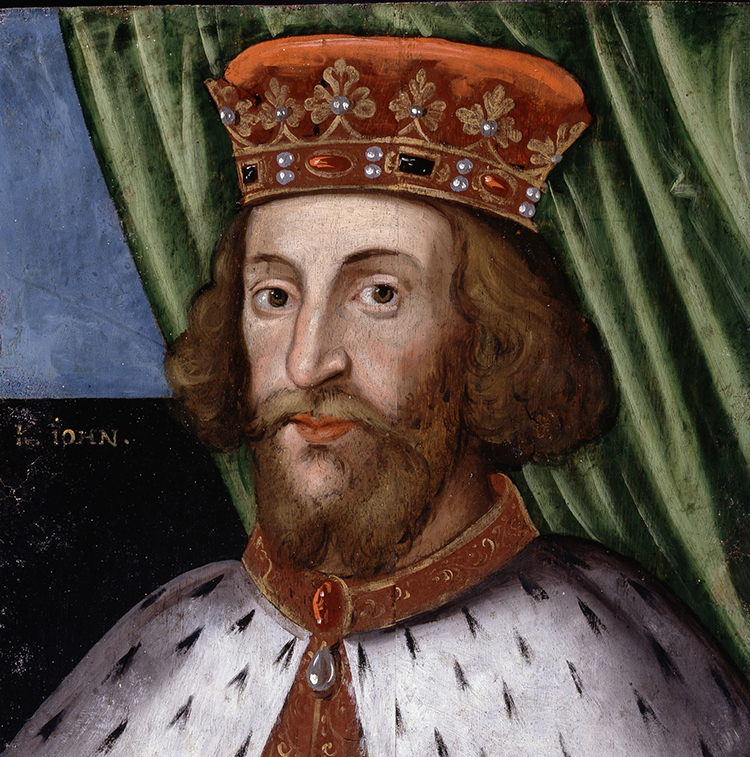
King John
I referred earlier to the historically-important claim that the Barons of Northern and Eastern England met in the Abbey Church in Bury St Edmunds in 1214 to swear an oath that they would make King John accept the Charter which they had drawn up. The barons had long-standing grievances against the King. John’s wars, fought to retain, and later, to recover, the continental possessions of the House of Plantagenet, had been a constant drain on the wealth of the country and his methods of raising revenue to fund these wars, had caused bitter resentment. The fines and dues under feudal law were set at exorbitant rates and for failure to pay, men were imprisoned, their lands seized and pillaged, their possessions confiscated.

John’s last campaign leading to the loss at Bouvines in 1214 proved to be a disaster too far. All hope of recovering Normandy for the English crown had vanished together with the expected spoils of victory to compensate for the financial cost of the expedition. The Barons had suffered most and they were determined to secure themselves against future arbitrary demands for money, against any future infringements “of their liberties” as they styled it. They sought a pledge that John would be powerless to break, one protecting their rights to enjoy their lands and property without arbitrary interference.

King Henry 111
1216-1272

The armed Barons met John at the Temple in London in January 1215 demanding he grant a charter guaranteeing ‘their ancient liberties.’ John temporised, promising an answer in Northampton in April and when he failed to appear there, the barons renounced their fealty to the Crown and seized London, including the Exchequer. John was forced to capitulate. Under the expert guidance of Stephen Langton, Archbishop of Canterbury who acted as lead negotiator, John conceded the formal grant of the ‘liberties’.In the meadow which is called Runnymede between Windsor and Staines,” half way between the two opposing camps, a formal grant of the liberties was made, reinforced by ceremonial pomp and flourish. Letters were issued to sheriffs and bishops throughout the land informing them of the terms on which peace had been concluded; copies of what came to be called Magna Carta were distributed, and the barons renewed their homage to their King.

Stephen Langton 1150-1228.


Stephen Langton, a distinguished theologian and canon lawyer had lived in exile during a long dispute between King and the Pope. On his return to England in 1213, and his elevation to the Archbishopric, he had cannily demanded the King’s reaffirmation of his coronation oath which guaranteed the liberties of the Church. Thus, his leading role in the definition of the rights of the secular barons, accepted by both sides, proved crucial and led to the final version of the Magna Carta, embodying the principle that the King was bound by law in the exercise of his monarchical power. The barons were equally bound in the exercise of their powers and this gave protection to all ‘free’ men.

John quickly obtained a release from his ‘promises under duress' from the Pope while the barons wisely kept their hold on London and civil war inevitably ensued, stopped only by events after John’s death from dysentery in 1216. The Magna Carta was issued as the Coronation Charter of John’s nine year old son and successor, Henry, thanks to Stephen Langton’s foresight, and led to the end of the civil war in the following year. However, throughout the thirteenth century, six demands for the re-issue of the Magna Carta, [the Great Charter] were made as the struggles between monarch and barons ebbed and flowed. Not until 1297 at Edward 1’s coronation was the Magna Carta finally placed on the Statute Book to become part of the law of the land.

Serfdom

Wherefore it is our will, and we firmly enjoin, that the English Church be free, and that the men in our kingdom have and hold all the aforesaid liberties, rights and concessions, well and peaceably, freely and quietly, fully and wholly, for themselves and their heirs, of us and our heirs, in all respects and in all places for ever, as is aforesaid.”

Ref: 'Magna Carta' by W.S.McKechnie. 1914

The original Magna Carta referred to the 'men in our kingdom' but these were the so-called free men, not the serfs. Gradually, over time, however, this limited class of men expanded to include every citizen. In the seventeenth century, under the Stuarts, under the tyranny of the perceived 'absolute monarch', the Magna Carta was used as a statement of the primacy of the rule of  law over the power of the Crown.

Interestingly, when rebels in America fought to establish a free and independent state in which the law would defend citizens against oppression, their Declaration of Independence consciously embodied the concepts of the Magna Carta and eventually, became the Constitution of the United States of America in August 1776.
.

The Plantagenets: 14 Anglo-Norman monarchs from 1154-1485

Part of the Salisbury Magna Carta.

Four attested copies of the Magna Carta have survived. Two are in 
the British Library; one is in Lincoln Cathedral and one
in Salisbury.


Ref: 'Magna Carta' by Daphne I. Stroud 1980


Friday, April 1, 2022

Not Standing Still; Looking Round .....


View of the small terrace with the one plant,
a lovely rhododendron smuggled in from Bruges,
the only one so re-sited.

View of the nascent planted terrace with proprietor!

Feel somewhat frustrated sometimes at my slow rate of progress in settling in. It has become rather difficult for me these days, to juggle several balls in the air, simultaneously; indeed, as I often remark to myself, “Multi-tasking used to be the order of the day. Now, uni-tasking takes a lot of effort!” So I must make myself count the positives this week. 

Bedside lights installed. Extra socket in study and an outside socket on the large terrace. Shower room mirror removed and installed in bathroom with that mirror, rendered less attractive by some short-term tenant who snipped the neutral cable, ready to pass to grand-daughter who doesn’t need the electrical sideshow of illuminated dots. New, better-lit mirror has yet to arrive for my en-suite, but hopes are high. Water butt and pump ready on the terrace and in use. Gorgeous blinds in bedroom and study put in place about twelve hours ago! But the intended curtains for terrace door from living room, did not work and have been taken away. Refund hoped for there unless another solution can be found!! Painting of the living room postponed due to Covid but now timed for next week.

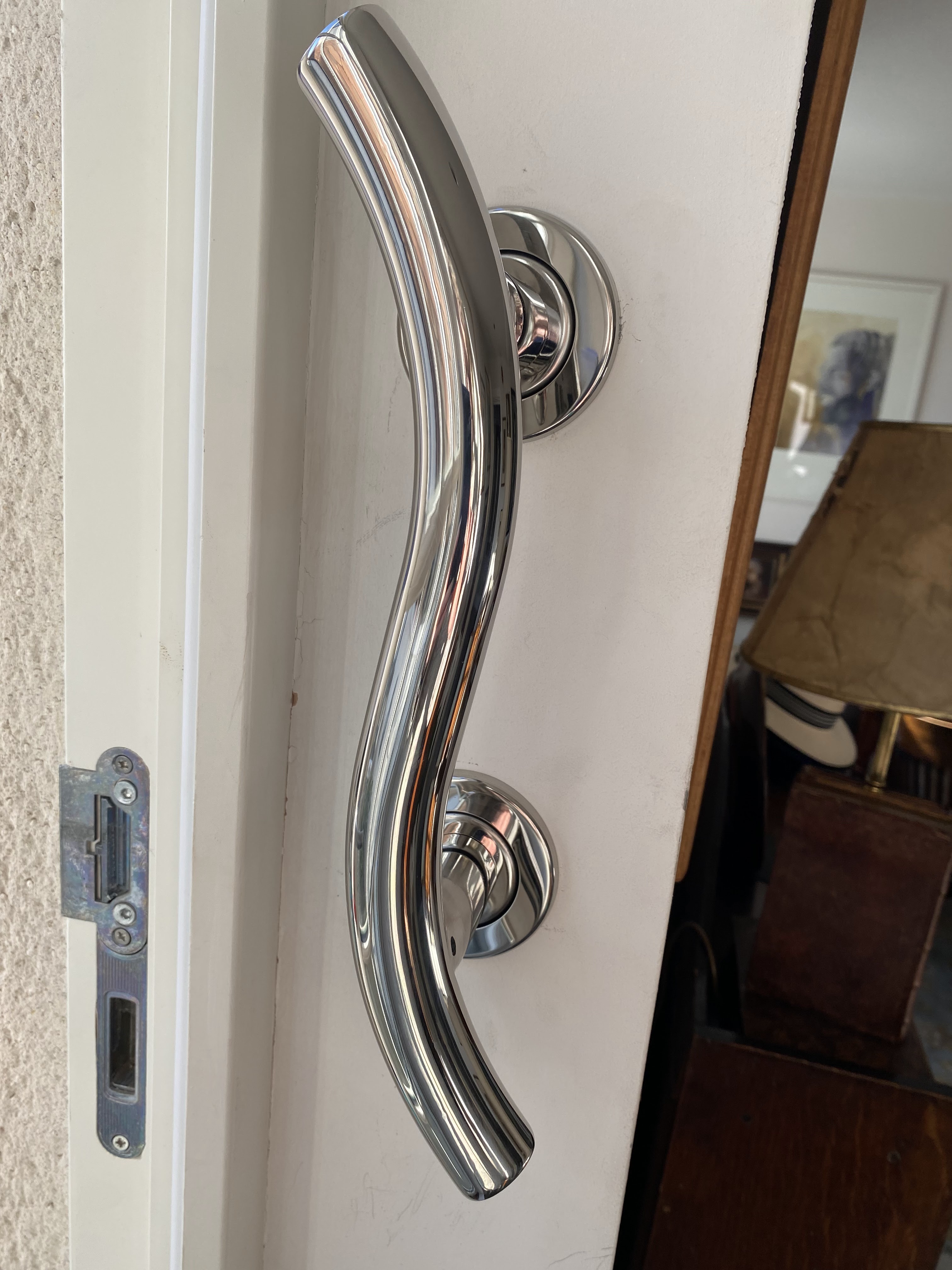
Quite forgot to mention trendy
new grips to help the aged over
various thresholds.

Progress however on the Mah Jong front. Two other interested parties have popped up in response to an appeal by a new friend, on Nextdoor. One is a woman who plays ‘Hong Kong Four Winds Mah Jong’ on her phone and would prefer to play only twosomes; plus a girl who played one Christmas decades ago, with a Thai friend and wants to learn. The latter sounds blissfully normal! We meet in a cafe tomorrow afternoon and attempt To Begin!! Progress indeed. Almost simultaneously, the formerly unproductive U3A Mah Jong group, membership promised for next October, is now to have two extra sessions tacked on to the March series, during April. I have the address, have been invited and will have the necessary Lateral Flow Test as required!! Looking forward to this one if only to meet the gent in charge who seems a trifle cautious and careful, if not constipated. I shall pack my mask too with the ingratiating smile!!

Mother’s Day last Sunday saw me, for the first time for around half a century with two out of three offspring with me. Lunch at the Giggling Squid; delicious. Also to a garden centre to buy compost, gravel and a few hardy plants. We did this on the Saturday with Olivia also here for a final wedding dress fitting in town. Had a marvellous time and we returned home in high spirits. Livs and I put four small plants in the lift with us and the lift promptly stopped functioning. All phone calls proved fruitless and the gallant Olivia and David carried up the heavy sacks et al to the second floor. Lift repaired on Monday afternoon and plants retrieved. We planted and swept on the Sunday after Livs’ early departure, and put the finishing touches to a perfect Mother’s Day weekend!! My protests at the lack of speedy attention re the non-functioning lift met a stone wall of indifferent explanations: ‘It was not an emergency.’ I’m discovering the little differences between leasehold and freehold!!

A sunny walk in the Abbey Gardens recently.

I have made a few early morning walks, mainly in and around the wonderful Abbey Gardens and keep dazzling myself with the historical bounty that there is in Bury St Edmunds. The town, in essence, was mediaeval, growing up around the Abbey, built in 1020; suppressed in the Dissolution of the Monasteries in 1539 via Cromwell’s machinations on behalf of Henry V111. I discover that the motto of the Borough is “Sacrarium Regis, Cunabula Legis.Shrine of a King, Cradle of the Law, The King is St Edmund, King of the East Angles, who was killed by marauding Danes in 869 A.D. His shrine stood for centuries in the Abbey in Bury St Edmunds and from him the town derived its name. “Cradle of the Law” refers to the tradition that, in 1214 A.D. the Barons of England met in the Abbey church and vowed that they would force King John to accept the Charter of Liberties which they had devised and intended to present to him. This became known as the famous Magna Carta. History indeed. There is a further Henry connection. St Mary’s Church near the Abbey, was built in the 15th century and Mary Tudor, Henry’s sister, is buried there. It is remarkable and deeply sad that Henry’s greed for gold and wealth caused the eventual destruction of the magnificent Abbey, perhaps the greatest Benedictine monastery ever in England.

An altogether more misty moisty view
of ruins in the Gardens this week
somehow underling the enduring loss
caused by an entitled, rampant ego.


Thinking Back at 92.

Probably our birthday.  1951. 11,15,17. July 1941, Front lawn, 14, Lindhurst Lane, Mansfield, with Dad. Ages: 1,5,7. Averil, possibly 1936/7...