 |
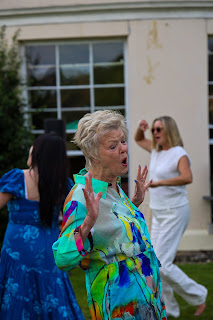
Celebrating my 90th
|
As I approach my 91st birthday, I have,
surprisingly to myself, but perhaps inevitably to others, been thinking about
the pros and cons; the ‘how’ and ‘why’, of living a long life. It doesn’t
require a PhD in health economics to acknowledge no one would opt for a long
and unhealthy life but, if one accepts the desirability of a long and healthy
life, how might that be acquired?
This is not a question with which I have wrestled yet now,
on reflection both in mirror and memory, I see, to a degree, that I have attained
that. I take no regular medication, have had no major operations nor suffered
from malfunctions of heart and lungs nor other appendages like legs, arms,
feet, hands etc. The one major hiccough for me, important and unexpected, was the M.E. which stopped me in m
y
tracks in my mid-fifties. Myalgic Encephalomyelitis came after I had worked over-long
but happy hours every week during a quarter of a century, both professionally in
education, and personally, with family and relationships. M.E. cut me down like a
tall flower felled, taking energy and immediacy of action, removing my career and
reducing my personal life to that of an elderly invalid. I experienced degrees of illness
for around three years, but it took 20+ more years for M.E. to very gradually dissipate. During this long period, I certainly developed both physical
and mental awareness of how to avoid the onset, and deal with the effects, of
M.E. and I do wonder if the reflection and habits then perforce, developed, contributed to the subsequent
long years of good health. Almost certainly. I never gave a thought, in my
earlier years, to eating well, sleeping well, avoiding negative stress, exercising etc
which I now consciously see as essential but also as normal.
 |
| NHS emphasising Prevention |
The spur to my current introspection is twofold
. First,
the announcement this week that the Government, aka Keir Starmer and Wes Streeting,
wants to turn the emphasis of the NHS from
treatment to prevention, an entirely
admirable undertaking. Second,
The Guardian, 30/06/2025, which yesterday featured details
of an in-depth enquiry into National Health Inequality. The results were
horrifying and depressing, starkly revealing that, despite the splendid N.H.S,
founded on the principle of providing healthcare free at the point of need,
still poverty and ignorance produce vast disparities in health outcomes. But
individual poverty and ignorance are not the sole determinants, as the
following list demonstrates:
1. 1. Poverty certainly. Relative poverty is one of
the strongest predictors of poor health outcomes. Food insecurity, poor housing
and probably limited access to healthcare are more likely to be experienced by the poor.
 |
| Sub-standard housing |
. 2 2 Education. Lower educational attainment is
linked to poorer health literacy, limited employment prospects and increased
risk of unhealthy behaviours.
3. 3 Employment. Job insecurity, hazardous work and
unemployment are associated with higher rates of mental and physical health
problems.
4. 4 Housing and Environment. Substandard housing, domestic
overcrowding, exposure to air pollution, all disproportionately affect the poorest.
For instance, men living in affluent Kensington and Chelsea, may outlive those
from parts of Glasgow or Blackpool by more than a decade. Through a series of
pioneering schemes in North-West England, clinicians have discovered what one NHS
manager described as ‘mediaeval’ levels of untreated illness. In several
poorer areas, GPs and community nurses have virtually disappeared, A&E attendances
have almost doubled since 2010 driving up ambulance call-outs by 61%.
 |
| A&E overcrowding is common. |
5. 5 Access to Healthcare. Theoretically, open to all
in need, there are nonetheless, cultural linguistic, informational and sometimes,
geographical, barriers to accessing the N.H.S.
6. 6 Lifestyle Factors such as smoking, excessive
alcohol consumption, poor diet are all more prevalent among disadvantaged
groups and ruthlessly targeted product advertising exacerbates difficulties in access
to healthier options.
 |
| Choices! |
I set out to write a few musings on living
a long and healthy life but seem to have strayed into a consideration of health inequality
in national British life. The Guardian spent months interviewing GPs, nurses, social workers, NHS leaders, and academics, plus residents living in some of the most deprived areas in Britain, to assemble its National Health Inequality project, The results are deeply disturbing. One learns, for instance, that Britain has the lowest life expectancy in western Europe and
one of the highest numbers among rich countries for preventable deaths. My next
blog just has to be on the areas of worst deprivation in England as I silently
appreciate the luck of my own life journey from poor working-class family with
work-shy, angry, self-centred father, to still functioning nonagenarian. In all fairness I must add
that echoes of my father’s better attributes; intelligence, exceptional memory,
courage to stand alone, willingness to respond if threatened, may well have
descended in part to me. I hope his less attractive qualities have not filtered down too but it is not for me to judge!


