Friday, June 28, 2024

Seen Around

 Wandering towards the familiar Abbey Gardens early-morning-walk path, I noticed a nearby display of what I correctly judged to be some children’s work. On inspecting it I discovered indeed the display was

Bury in Bloom community display in
the Abbey Gardens
display was of some Primary schoolchildren’s work under the umbrella [or perhaps, parasol] of Bury In Bloom, an organisation run, I always supposed, by sturdy, confident Lady Gardeners committed to beauty in the public realm. And it probably is but this time, the Ladies were looking to educate and inculcate. There is an indication headed: 

           Celebrating 60 Years of Friendship, Bury In                            Bloom friendship and flowers bloom and grow.

A further notice reveals that the display is made not just by schools, but also by those in care homes and community groups and gives names of groups and occasionally of children. The display consists of lots of large flowers fashioned out of chiefly paper and card, placed in huge tubs painted in psychedelic colours and patterns. Looks delightful but even more satisfying are the notices planted among the flowers and pots, suggesting ideas for others to follow to live better lives. All inspirational stuff!

A floral contributor


Invite a friend round to your house to play and share your toys with them.” Westgate Primary School.

Our Motto says it all: Friendship, Love and Truth." St. Edmundsbury Oddfellows.

If someone looks lonely at playtime, ask them to join your game.” Sebert Wood Primary School.

I have to say in a completely open and non-cynical way, that the whole ensemble raises the spirits and most definitely, a smile. It reminds too of the shining innocence of small children and the wholly positive view of their early world they have. As I have been reading the poetry recently, of Philip Larkin, notoriously depressing and world-weary, this counterpoint is optimistic and joyful! In fact, heart-warming!

Angel Hotel

This morning, en route home via the ‘underpass’ of the Angel Hotel, behold a splendid sight. Some sort of red racing car with lots of external pipes and what seemed, ‘extras’. It is only now that I see from my quick photograph, en passant, that there don’t seem to be any back wheels.! To my inexpert eye, it does look as if concocted from a kit but nonetheless, it also looks dashing and infinitely desirable. And it reminds me of what an old friend, now departed, would have called it: she would have said it was an absolutely spiffing motor! And so it is, especially if it actually works! I do wish I had gone into the Angel to try to discover more about the red racer this morning but I didn’t think of it; later I went back but the glorious construction had gone!

Fabian with his splendid equipment

Again en route home, but this time, from the hairdresser at the corner of High Baxter Street and Brentgovel Street. Jenny the Hair, had told me that a recently-opened coffee shop along High Baxter, had been warmly recommended by a couple of her clients. So, on impulse, I located AlemaCoffee, not a difficult job in view of the new external painting in a strident fuschia colour!! More knicker-shop than coffee-shop BUT this is the first coffee shop I have seen in Bury St Ed run by someone who knows and understands coffee! Fabian, the owner/barista is from Ecuador; his father runs the family coffee farm in Ecuador from where Fabian obtains his coffee beans, all stored in full view in large boxes piled up in the shop. To hear Fabian explain the differences and properties of arabica and robusta coffee beans is to hear a special kind of poetry! The place is tiny, furnished with some impressive-looking [and beautiful] brass equipment for roasting/ grinding etc There are the too-numerous boxes of beans, for which Fabian feels he cannot afford alternative storage, and scant seating for perhaps five or six people. Fabian is also a chef and opens his coffee bar for short days to enable him to cook elsewhere in the interests of solvency. As a coffee-lover who limits herself to one cup a day providing it is Good Coffee, I have to admit that Fabian is no ordinary barista and that  s  coffee [‘House motto: From Farm to Cup’] is super. AlemaCoffee is warmly recommended to one and all.

Thursday, June 20, 2024

Stolen Nazi Art

 l

Jardin de Monet a Giverny
Claude Monet


Very interested to read of the revelation this week that the Kunsthaus Museum in Zurich intends to remove five paintings from public view on June 20 as it collaborates with the owner of the five artworks to investigate whether they might have been looted by the Nazis during WW2. One of the reasons that this caught my eye was that one of the five suspect works of art is Jardin de Monet a Giverny by Claude Monet! My grand-daughter, Niamh, and I visited Giverny for a delightful couple of days last September, her first visit with which she seemed enchanted. As was I! And we seem to have developed a certain personal possessiveness about the famous garden! 

 
Portrait of the Sculptor, Louis-Joseph
Gustave Courbet
 The remaining four paintings removed from public view are pictured below, plus one under review.

La Route Montante
Paul Gauguin
 All five paintings are part of the Buhrle Foundation collection focussed chiefly on French Impressionist and Post-Impressionist works and are a core part of the Kunsthaus display on long-term loan from the Foundation E.G.Buhrle which has requested the removal of the five while it assesses their provenance. This move has been prompted by the March 2024 publication of the U.S. State Dept’s latest ‘Best practices for handling Nazi-looted art.’ These expand the Washington Conference Principles on Nazi-Confiscated Art set out in 1998 which focussed on providing restitution to the families of the original owners for treasures that were either stolen or forcibly sold by the Nazis.

The Kunsthaus 
The Kunsthaus has published an apology for the current removals, acknowledging its regret but also supporting the decision of the Buhrle Foundation ‘in acting correctly and comprehensively’ in its decision. Meanwhile, the Buhrle Foundation published the following: “The Foundation strives to find a fair and equitable solution with the legal successors of the former owners of these works, following best practices.” It is also conducting a separate investigation of a sixth work currently on display at Kunsthaus Zurich, Edouard Manet’s La Sultaine.

Emil Buhrle during WW2

 Emil Buhrle was a German-born Swiss industrialist and arms manufacturer whose passion was collecting art. During the war, despite the fact that he used child labour and forced labour, he was permitted by the Swiss government to sell arms to both the Allies and to the Nazis and by the end of the war, had become Switzerland’s wealthiest man. Both during the war and after, Buhrle continued to buy art on a massive scale and suspicions have long endured about the provenance of some of the works in his possession.

In 2021 an extension to the Kunsthaus in Zürich, Switzerland's largest art museum, opened, with almost an entire floor dedicated to paintings and sculptures on 20-year loan from the Bührle Foundation. This drew criticism due to Bührle's Nazi-era weapons dealings, and his use of forced labour and child labour in his factories at the time. Up to 90 of the works loaned to the Kunsthaus are thought possibly to have been acquired illegitimately from Jews; historian Erich Keller said "We need independent research into the art's provenances, and then to consider which of these paintings really belong in the Kunsthaus and which need to be given back." The Bührle Foundation's director responded that "The approximately 90 works are works for which no complete provenance is known, but for which there is also no reason to assume a problematic provenance".

Hundreds of thousands of paintings and millions of books as well as cultural and religious artefacts were stolen from Jewish owners by the Nazis during the Holocaust. Many have not been returned to

The Old Tower
Vincent van Gogh
their original, rightful owners. During WW2, though Switzerland remained neutral, it also retained strong economic ties to Nazi Germany and its allies. An article about Nazi-looted art from the National Archives’ Holocaust Records Preservation Project states that:

Confiscated artworks were often saved for private Nazi and German collections, while some pieces were sold through neutral countries like Switzerland to raise capital for purchasing additional art pieces and to purchase materials for the Nazi war machine. Additionally, Switzerland offered a large market for ‘degenerate art.’

During the Thirties, the Nazis declared that a variety of modern art and artists were sick and immoral. The regime called this Degenerate Art and in 1937 they confiscated thousands of examples of this so-called degenerate art, displaying many in the Degenerate Art Exhibition of 1937. Many thousands of examples were simply destroyed.

La Sultane Edouard Manet
Not removed but under review

Portrait of the Sculptor, Louis-Joseph
Gustave Courbet


Thursday, June 13, 2024

Facing Up To Inadequacy

Leader of the Flemish
Primitives.
Jan van Eyck
1436

 Earlier this week I was due to give a talk to the local Art Appreciation U3A Group and off I swanned, generously prepared as I had twelve pages of script and 76 images, all on The Flemish Primitives, and all well-rehearsed. Slight twinge of surprise to learn that the regular guy who understands how to convey my USB images into the projector probably via laptop or I-pad, and thus to the screen, was on holiday. Obviously this casual attitude to important duties, should be outlawed but there it was and two lovely male members of the group were on hand to perform the necessary magic. As the male ego is inclined to facilitate self-belief, they both looked confident and capable and my immediate stab of dismay on the initial news, hovered uncertainly as they busily thrashed about among the black cables. Twenty minutes later as the elderly audience waited expectantly and the screen stayed empty, I decided I would have to go ahead without benefit of the illustrations. Old age does at least confer a philosophical approach to disaster and under the banner of Luther’s, “ I stand here, I can do no other” I waded in. Ten minutes after the ‘get-go’ as Americans are wont to say, a picture appeared on a quite large laptop screen on the table nearby which some of the audience may have been able to see distantly but which I couldn’t consult as it was at right angles to my view. I did occasionally ask which picture was on board, the laptop was turned and I had to stop delivering my talk to be able to see it; it was, of course, never the image to which I was speaking!

Gerard David. 
The Holy Family 1520
The following one and a half hours were a bit of a shambles, pictorially speaking, though my script was fine. It must have been a mystifying challenge, shall we say, for the listeners/  viewers, but several kind, polite people came up to thank me at the end. I stopped after the first half of my talk, at the end of the narrative about Jan Van Eyck and three of his masterpieces, leaving three more artists of the period to be covered at what the Boss man suggested, might be in next year’s programme. At the moment, it is now booked for October and I am busily adding one more artist [Gerard David] to the yet-to-be-delivered talk for it to better stand alone while trying to banish the Imposter Syndrome feeling I am experiencing. I am certainly not underqualified to give a talk on Flemish art and nor was I unprepared but the feeling of exposure last Monday was quite brutal and embarrassing, even though the mess was clearly not my fault but I do have a feeling of inadequacy-by-association!

And, thinking of inadequacy, I propose to banish thoughts of the politically-inept Sunak’s slightly early departure from the D-Day remembrances and his

Rishi Sunak
subsequent exposure to the cruel delight and mockery of the U.K. population. Although one does wonder what on earth his political advisers were thinking of! However, I also have a quote on Trump for which sadly, though I copied it down, I neglected to add the source! However, it is so perfect I quote it here in all its witty succinctness! The person who unwittingly provided this quote,  acknowledges the unfitness of Trump to govern, and speaks of, “the chaos wreaked by an ego unable to grasp its own ineptitude.” I should note that Trump, increasingly and bewilderingly, emerging as the favourite in the upcoming U.S. Presidential election, keeps demonstrating in his recent speeches, that he intends to demolish democracy in the U.S. and use the power of the state to punish his enemies and critics. Robert Kagan uses the memorable phrase, "his deep thirst for vengeance."  I would say that feelings of inadequacy are unknown to Donald.

Trump


Monday, June 3, 2024

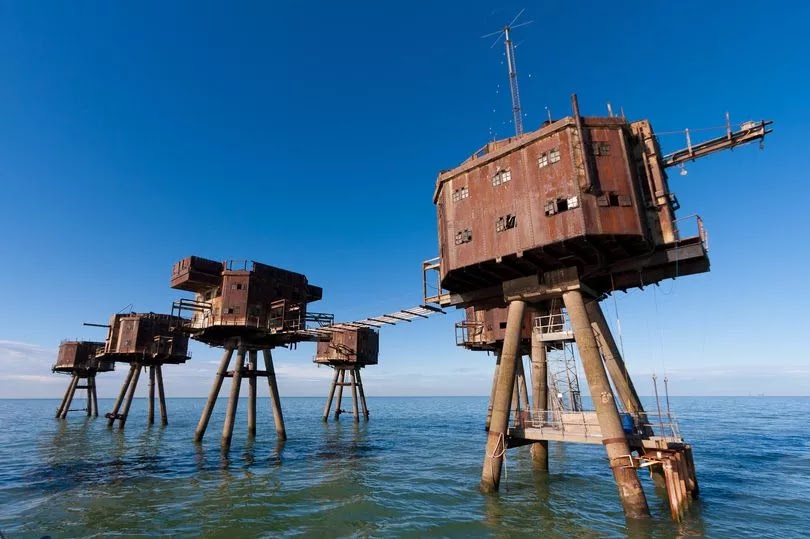
Maunsell Forts


A Maunsell Fort
Each fort was a cluster of seven individual giant boxed
steel structures on top of huge reinforced lattice girders

I half heard an allusion to “Shivering Sands” on Radio Four a few days ago and began to listen to a broadcast on what I eventually understood to be the Maunsell Forts. They were/are off the coast near Whitstable in Kent apparently, and I was mystified that, after living in Kent for over 30 years [until 2015] and with a stepson living in Whitstable, that I had never before heard of these forts.

Possibly 1939
My youngest brother, who lied about
his age, was fighting with the 
Sherwood Foresters at Monte
Cassino when he was only 17.

It is a long time since WW2 [1939-1945] during which time I grew up through Primary School to Grammar School in 1945. I do have strong contemporaneous memories of those years, but they are of sisters, childhood, playing and den-building over long summers in the large wood next-door to our garden and of the daily play-time with ‘my gang’. And of course, importantly, avoiding my father when possible. I did know that Hitler was bad and that Uncle Joe Stalin was good. Two of my half-brothers were in Army uniform; the other two were not, one being a train driver [essential to the war effort] and the other pronounced unfit to serve after an horrendous car accident. I knew that Johnny Ball who lived nearby had been killed in the war and that there was an American Army camp in the big field beyond the wood next-door and when soldiers from there walked past our front gate, my sister Esme and I knew to shout, “Have you got any gum, chum?” and we were sometimes rewarded. Rural Nottinghamshire was spared the terrors of London bombing although one of our favourite games was, ‘Being Bombed Out’ (which we had never experienced!)
S S Richard Montgomery 1940

The Port of London had always been one of the busiest in the world and at the height of WW2 it remained one of the few ports still able to receive ships containing valuable supplies to keep the country on its feet. As a result, the shipping channel, visible from Whitstable, became a frequent target for German mines as well as serving to guide enemy bombers to the capital. The enemy mine-laying in that channel, was so successful that, by 1940, over 100 British ships had been sunk in the Thames Estuary. Something had to be done!

Guy Maunsell, a highly-respected civil engineer, interested in concrete and the recent progress in experimenting with concrete for non-traditional

Guy Maunsell  1884-1961
use, was approached to come up with ideas to deal with the problem. He had gained useful experience of concrete design and construction techniques through his involvement in the building of the Storstrom Bridge in S.E. Denmark.

He proposed Martello-like constructions, suitably amended. [The Martello Towers were land-based coastal fortifications built during the Napoleonic Wars in the early nineteenth century.] Maunsell created plans to build off-shore forts, built on concrete bases, towed out to sea then sunk into the sea bed. Despite his designs, ready by November 1940, being met with some doubt, nevertheless, his plans for four gun-emplacements/off-shore forts were given the go-ahead on 6 March, 1941, built for the Royal Navy, to his design, and installed between 1942 and 1943. Each fort accommodated [one suspects, to Spartan standards] up to 265 men on five floors and they manned and maintained anti-aircraft guns mounted on the top ‘deck’ of each fort. During their time in operation, the Red Sand and the Shivering Sand forts between them, shot down 22 German aircraft and 30 V1 doodlebugs [flying bombs]; they also participated in the sinking of the one U-Boat successfully dispatched! Several more forts, for the Army, were similarly installed in the Mersey Estuary, a total of seven Maunsell Forts in all.

Locations of the seven Maunsell Forts

When the war ended the sea forts remained manned until 1953 when there was talk of dragging them back to shore to be dismantled but this idea proved too expensive, and so, stripped of all machinery, they were abandoned. They have become an embedded part of the coastal view with artists and photographers including the forts, huge and stark and striking, in Whitstable photography projects.

Over the years a number of pirate radio stations have used them for illegal broadcasting; Screaming Lord Sutch for Radio Sutch and Invicta Radio were two in the Sixties. In the summers of 2007 and 2008, Red Sands Radio, commemorating the pirate radio stations of the Sixties, briefly operated from there until the fort was declared unsafe and moved to Whitstable.

Map of British ships sunk in the Thames Estuary
1939-1945
Wartime residents of one of the Forts


'The Navy' on board in action in the early 1940s


Sunday, May 26, 2024

Tom Lehrer


Tom Lehrer in 1983

The trigger for this particular blog was the fact that I bought a copy of The Guardian on Wednesday 22 May [I allow one actual newspaper a week, max. More would mean I did nothing else but read newspapers which is not a shameful occupation; people from my generation gratefully acknowledge newspapers as the primary news source for the discerning.] In the paper was a double spread on Tom Lehrer about whom I haven’t thought for years. It was enough to send me to my relatively sparse remaining CD collection to dig out my one and only Tom Lehrer CD. [probably the '65 edition.] Of course, when I played it, I was incredulous that so much time had passed since it was last heard by me. It remains as sublime as ever and I’m ashamed to have forgotten to play it, though Tom would understand that Life got in the way.

Francis Beckett

Tom in his fifties

The Guardian article is by Francis Beckett, a long-time Lehrer worshipper, who, following Lehrer’s statement in 2020 that he had placed all that he had written in the public domain, generously making his lyrics and sheet music available for anyone to perform or use without paying royalties, decided he could then afford to write a show he had long had in mind, about Lehrer. The Fringe Theatre, Upstairs at the Gatehouse in Highgate, agreed to stage his eventual production called Tom Lehrer is Teaching Math and Doesn’t Want To Talk To You. This is now scheduled to run from May 28 to June 9 and my big current regret is that I am not up to journeying to Highgate to see it!!

And why this hero worship? Lehrer, born into a wealthy New York Jewish family in 1928, was a child maths prodigy who entered Harvard at 15 in 1943, took a first class maths degree at 18 and acquired a Masters a year later. After graduation in 1946, he worked at Los Alamos Scientific Laboratory before becoming a Maths Professor at M.I.T. apparently without effort but his talent, his “prodigious talent” as described by Beckett, has been for composing bitingly caustic, musical social comment and criticism. But his work is also wonderfully funny too with magical, stunningly harsh, but light-heartedly irreverent turns of phrase and comment. The music is jaunty, catchy, memorable and induces a novice’s desire to ape the Master or, at least, applaud or echo. Frankly, Lehrer is for the satire-obsessive set to music.

Fortuitous photograph of squirrel and pigeon
in the Abbey Gardens
Almost always, as I walk through the Abbey Gardens early each morning, there are dozens of pigeons busily pecking and snuffling in the grass, I always happily greet them and their companion squirrels but I always silently sing remembered remnants of Lehrer’s Poisoning Pigeons In The Park as I smile benignly at the birds. I love the familiarity of the song, and, it must be said, pigeons; but I cannot resist Lehrer’s subversive lyrics.

Spring is here, spring is here
Life is skittles and life is beer
I think the loveliest time of the year
Is the spring, I do, don't you? Course you do
But there's one thing that makes spring complete for me
And makes every Sunday a treat for me

All the world seems in tune on a spring afternoon  /When we're poisoning pigeons in the park

Tom Lehrer singing 
Pigeons in the Park
Every Sunday you'll see my sweetheart and me
As we poison the pigeons in the park

When they see us coming
The birdies all try and hide
But they still go for peanuts
When coated with cyanide

The sun's shining bright
Everything seems all right
When we're poisoning pigeons in the park

We've gained notoriety /In the Audobon Society

With our games.

They call it impiety
And lack of propriety
And quite a variety of unpleasant names

In middle and old age

But it's not against any religion

To want to dispose of a pigeon.

So if Sunday you're free
Why don't you come with me
And we'll poison the pigeons in the park
And maybe we'll do in a squirrel or two
While we're poisoning pigeons in the park
We'll murder them amid laughter and merriment/
Except for the few we take home to experiment

                                                     My pulse will be quickenin'
                                                     With each drop of strychnine

                                                     We feed to a pigeon
                                                     It just takes a smidgin
                                                    To poison a pigeon in the park.”

Lehrer wrote and performed in the 1950s and 1960s but he suddenly gave it up in 1960 with a brief reprieve in 1965 when he re-emerged to write new songs for the American version of the British satirical show, That Was The Week (Year)That Was. A second CD resulted containing many new, even more hilariously naughty and overtly political songs, making fun of the Catholic Church in ragtime for instance: The Vatican Rag:Then the guy who’s got religion’ll/ Tell you if your sins original.” Plus three songs condemning nuclear weapons. He expressed his horror that Hitler’s chief rocket scientist was then working for the Americans: “When the rockets go up who cares where they come down/ ‘That’s not my department,’ says Wernher von Braun.”


At the height of his fame, in September 1967, he was made
honorary student in the Copenhagen Student Union

And then, Lehrer-silence, at  the height of his fame and, short of 40 years in age, as he spent the rest of a long life [96 in April 2024] mostly as an unknown maths lecturer, living in self-chosen obscurity with the maths courses he taught at a modest university level rather than at High Honours; he called it, “Maths for tenors” He also added, at the university of Santa Cruz where he remained from 1972 for almost 30 years, a course on the history of the American musical, one of his passions.

Francis Beckett who wrote the Guardian article suggests:

“… Tom Lehrer is a prodigiously talented man who has no interest at all in money for its own sake, or in money to wield power. He wants enough to be comfortable and to do the few things he wants to do, and he has that.”

I think that my favourite comment by Lehrer [from perhaps thousands] is:

Political satire became obsolete when Henry Kissinger was awarded the Nobel Peace Prize.”

[N.B. Kissinger spied for the F.B.I. as a student, on fellow students, in search of 'communists', and later, masterminded the carpet-bombing of Cambodia during the Vietnam War] 

Although, temptingly, there is also:

"If, after hearing my songs, just one human being is inspired to say something nasty to a friend, perhaps to strike a loved one, it will all have been worthwhile.

Plus, of course, there is "My songs spread slowly, like herpes."

When George W. Bush was President, Lehrer admitted, "I don't want to satirise George Bush, I want to vaporise him."

The Boy Scout Movement in Australia had him barred from entry in the Fifties. In 1958, five years after the release of his first C.D. it was released in the U.K. and the BBC promptly banned ten of the twelve songs on it.

All of Lehrer's work [he wrote  only 37 songs] can be accessed
free of charge on
tomlehrersongs.com


                                                              tomlehrersongs.com.


Thursday, May 23, 2024

Lieux de memoire.

Lavenham 
  
Upper Bridge Street, Wye, Kent
This morning, [21/05] to a superb U3A talk called Boom and Bust in Mediaeval Lavenham by Jane
Gosling. I was particularly impressed by the quality and variety of the speaker’s photos of the many mediaeval buildings in the large village. Several featured various Crown Posts in different houses and suddenly, seeing them, I was taken back to my own much-loved old house in Wye, in Kent. I had left in early 2015 after over thirty years in the timber-framed semi-detached late fifteenth century house on one of the main streets in the village. I could barely afford to buy it originally but felt it to be historically, a dream house for me, with its beams, inglenook, Crown Posts et al. Despite strenuous modernisation, much of the original remained to be treasured and enjoyed over the years and it became one of a very small number of homes in my life which I have totally loved. Eventually, when I was eighty, I accepted that it was becoming a little too hard to care for it and I could see that, quite soon, it would become an increasing burden.
Crown: upper part of an arch
Post: upright support

Happily for me, this realisation gradually happened and coincided with a sudden impulse to live in Bruges which I had visited, and admired, every year for over twenty years and the excitement of making that adventure happen, quite took the edge off bidding farewell to my much-loved old house. Almost painlessly, I left, to remember it so fondly, but this morning’s photos of Crown Posts in the Lavenham lecture, called up the strongest desire to picture dear old No 1 and the Crown Post to which I awoke every morning for so long! It evoked a sudden, almost visceral, longing, not to return, but to savour the memory and the reflections and reminiscences it called up.

Now, all of this Crown Post remembering calls to mind the concept of “home” which has a strong connection to the image of “house.” When I think of my childhood home, I remember the house which was familiar and always there but which I don’t particularly remember admiring in any aesthetic sense, [it was just ‘there’] though I did love the garden; the “side-piece” adjoining the long garden which wasn’t ours, though we girls colonised it with our miniature patches of gardens; and the front lawn with the large Buddleia tree and its myriad summer butterflies where we so enjoyed our joint July birthday parties at the long, borrowed table. All of that was loved but the most important feature about a home is the person, or people, who make it home plus


Part of my childhood home minus front lawn. 2017.

the feelings associated with that person, and by extension, that home. And that, for my sisters and me, was our mother. One safely protective, always loving, adult was enough to make our home which
embraced us, and remains still, part of my precious internal landscape of memory.

Similarly recalled with strong feelings of attachment and love is the large house and garden where my children grew up; a happy, busy, spacious home with a garden garlanded with many trees and shrubs, ivy-covered old stone walls, a large pond [or little lake] with a stream, lawns and a Victorian greenhouse beloved by only me, I think! For a time we had a small boat made and loaned by a friend and for more years than I can remember, the daring swoop over the pond of an aerial ride, made by my husband to the astonished delight of the children, and much admired by young visitors too.

Waingroves Hall, Derbys.
Georgian-built, late 1700s, probably constructed around
the original Jacobean Clayton House; Victorian entrance porch
added c 1880/90.


Readers should find:
Geneology Blog: Robyn and the Genies
Waingroves Hall, Derbys.
Monday 26 October 2015 entry.
where an embarrassment of riches awaits.


Woensdagmarkt 9, Brugge
My apartment was on the top (floor 3rd)  behind the seven windows
with an eighth around the right-hand corner.
The terrace was hidden behind the top left corner of the building.
I meant never to leave, till old age intervened!


Tuesday, May 14, 2024

A Little World Apart

Recent arrival; cosmos

The arrival of Spring has brightened my terrace beyond imagining. For a season much-anticipated, Spring still manages to surprise. My roof-top garden is treasured both for its aesthetic value but also because it gives me, in a small second floor apartment, an ‘outside’ where blackbirds and pigeons occasionally visit, where fresh air feeds the lungs; where I can sit or work or linger to savour the views, perhaps the part of the cathedral tower which is visible or a peep at the next-door terrace to check on their display! It is, in fact, the very heaven to settle in a not-too-comfortable chair, embalmed by cushions, to enjoy my evening Duvel while I read or think. There is always a calm beauty about the terrace but at this time of year, there is extra delight in the increasingly rampant foliage which seems to have doubled in size and variety on certain plants while unremembered little blooms shyly decorate emerging shrubs. Somehow, to wander my tiny ‘estate’ provides both a daily reunion with the plants and the views, and a simultaneous celebration of their beauty. And the world beyond seems refreshingly further away; somehow, below me!


My sister and I playing Mah Jong on
the Bruges terrace in 2018.
She is very appropriately attired.
When I lived in Kent, my small courtyard garden which contained both a small proper garden and a brick courtyard filled with pots of shrubs and young trees, was much loved. I said Goodbye, I thought, to all things earthy when I left, but then I found a wonderful rented flat in Bruges where I moved to live. It was large, central, with great views and, amazingly, had a large terrace which overlooked the nearby convent garden as well as the mediaeval square in front of the building. There began my education in terrace gardening which is similar, though slightly different, from proper gardening!! When eventually garlanded with flowers and foliage, it became a favourite space to entertain visiting friends and family as well as a perfect bower for solitary pursuits. Even doing my Dutch homework was almost tolerable out there!

It did not occur to me that I could find a small apartment with a terrace, in Bury St Edmunds, when increasing age made it sensible to leave Beloved Brugge. But thanks to family living locally, I had no need to look far and I speedily ‘discovered’ my present home with the long roof-top terrace described above AND the tiny terrace off the kitchen accessed via the small glass folding wall.


The Bury terrace with much-travelled
charming statue.

Entrance view of the roof terrace ....

A most decorative standard laurel,
complete with curly stem,
on the tiny kitchen terrace.

... and the far [street] end of the roof terrace.

Ithaka by C.V. Cavafy

Homer's epic journey to Odysseus. In mosaic. Ithaca, Greek island in the Ionian Sea   I recently read  for the first time ,  Ithaka, by ...